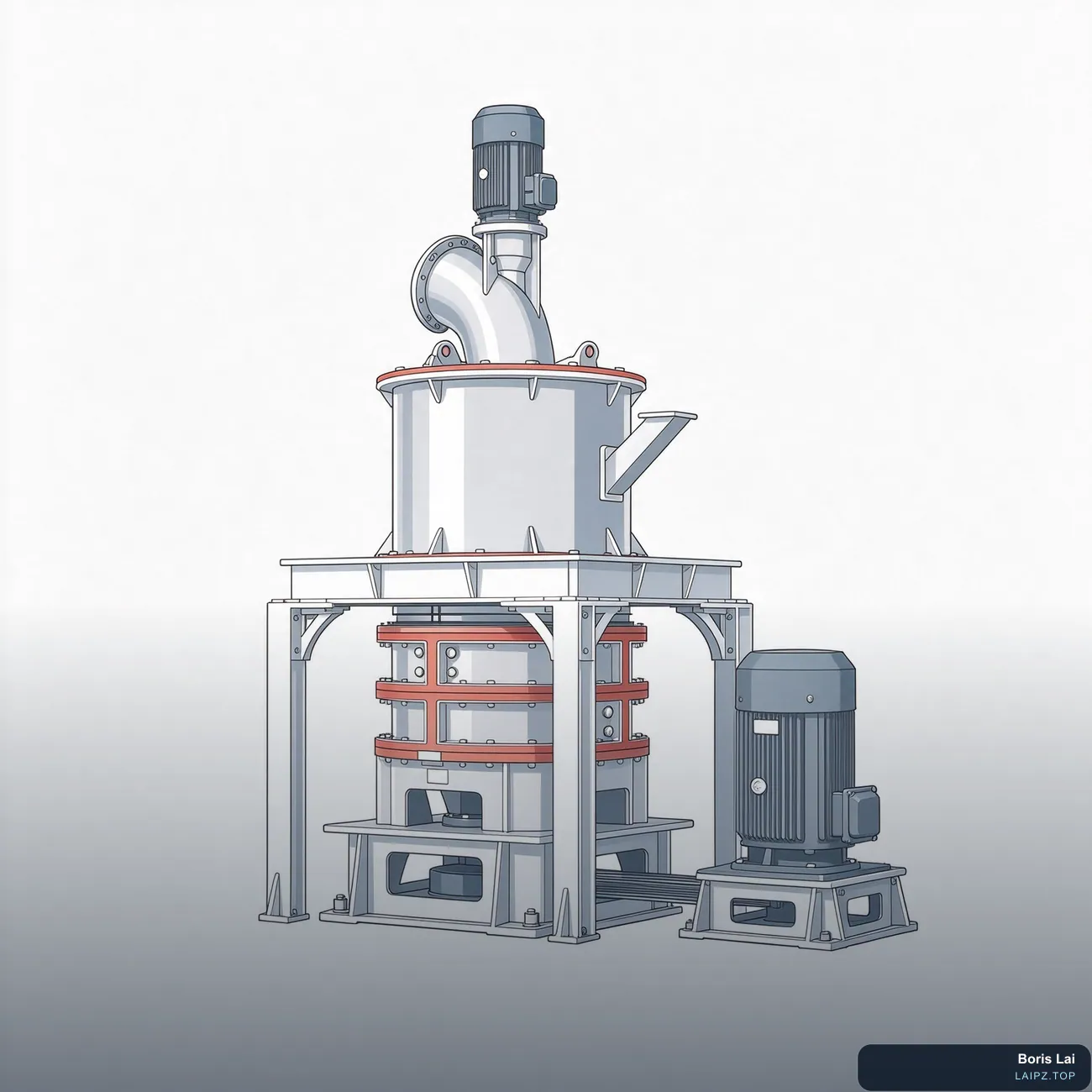
A Ring Roller Mill powder production line can integrate crushing, bucket elevation, material storage, controlled feeding, grinding, dynamic classification, pulse dust collection, air movement and noise-control equipment. The result is a compact powder-processing circuit for heavy calcium carbonate and other non-metallic minerals.
The correct system layout depends on the raw material, required fineness, target capacity, feed size, moisture, utilities and available workshop space. Each section performs a specific role in stabilizing the final powder.
1. Feed Preparation and Controlled Metering
Lump ore or suitable process waste is first reduced in a crusher to a feed size accepted by the mill. A bucket elevator transfers the crushed material to a storage hopper, where surge capacity helps separate upstream crushing from downstream grinding.
A feeder and inclined feed pipe deliver material at a controlled rate to the distribution plate above the main mill table. Stable feed size, moisture and flow are essential because sudden variation can disturb grinding pressure, airflow and classification performance.
2. Grinding Between the Rollers and Ring
The main motor drives the vertical shaft and table through the belt-pulley system. As the table rotates, shaft pins carry multiple grinding rollers around the grinding-ring track. Centrifugal action distributes material outward into the grinding zone, where the rollers apply compression, rolling and shear forces against the ring.
Material passes repeatedly through the grinding path and is progressively reduced. The combination of material bed pressure and circulation creates the basis for efficient fine grinding before the powder enters the classification stage.
3. Air Transport and Dynamic Classification
High-pressure air lifts the ground material from the grinding chamber toward the classifier. The rotating classifier impeller separates particles by size. Coarse particles are rejected and returned to the grinding zone for another pass, while particles within the selected cut leave with the airflow.
The Ring Roller Mill circuit supports a finished-powder range of 120-2500 mesh. Classifier speed, airflow and the operating condition of the grinding system must be balanced to achieve the required fineness range and particle-size distribution.
4. Powder Collection and Clean-Air Handling
The particle-laden airflow enters a pulse dust collector, where finished powder is separated and collected. Captured material is discharged and transferred to a finished-product bin for storage, packing or further handling.
Filtered air can then pass through ductwork and a silencer before discharge. Appropriate fan selection, duct design, filter maintenance, acoustic treatment and enclosure design help control dust, noise and working conditions around the line.
5. Decisions That Shape the Complete System
- Define the raw material, hardness, maximum feed size and moisture range.
- Specify capacity at the actual finished fineness, not only at a coarse setting.
- Clarify the required mesh range and particle-size distribution across 120-2500 mesh.
- Confirm available height, floor area, voltage, compressed air and site conditions.
- Include crusher, conveying, storage, dust collection, noise control and packing within the line boundary.