Technical matching
Review material properties, fineness, capacity and production-line interfaces before model selection.
Independent grinding mill brokerage
Ring roller mill is widely used for grinding non-metallic minerals such as calcite, limestone, talc, kaolin, calcium hydroxide and calcium carbonate, with a fineness range of 120-2500 mesh.
Technical matching, supplier comparison and project coordination by Boris Lai.
Built for overseas buyers who need a clear machine brief before comparing factories.
About the broker
I am Boris Lai, an independent grinding mill broker. I help overseas buyers clarify the right ring roller mill scope, compare qualified equipment routes and coordinate technical details with suppliers.
My role sits between the buyer's process requirement and the equipment offer. That means translating your raw material, target mesh and capacity into a comparable specification, then coordinating the commercial and engineering questions that follow.
Review material properties, fineness, capacity and production-line interfaces before model selection.
Compare suitable equipment options using one consistent technical and commercial checklist.
Help coordinate spare parts, documentation, shipment questions and installation contacts.

Product focus
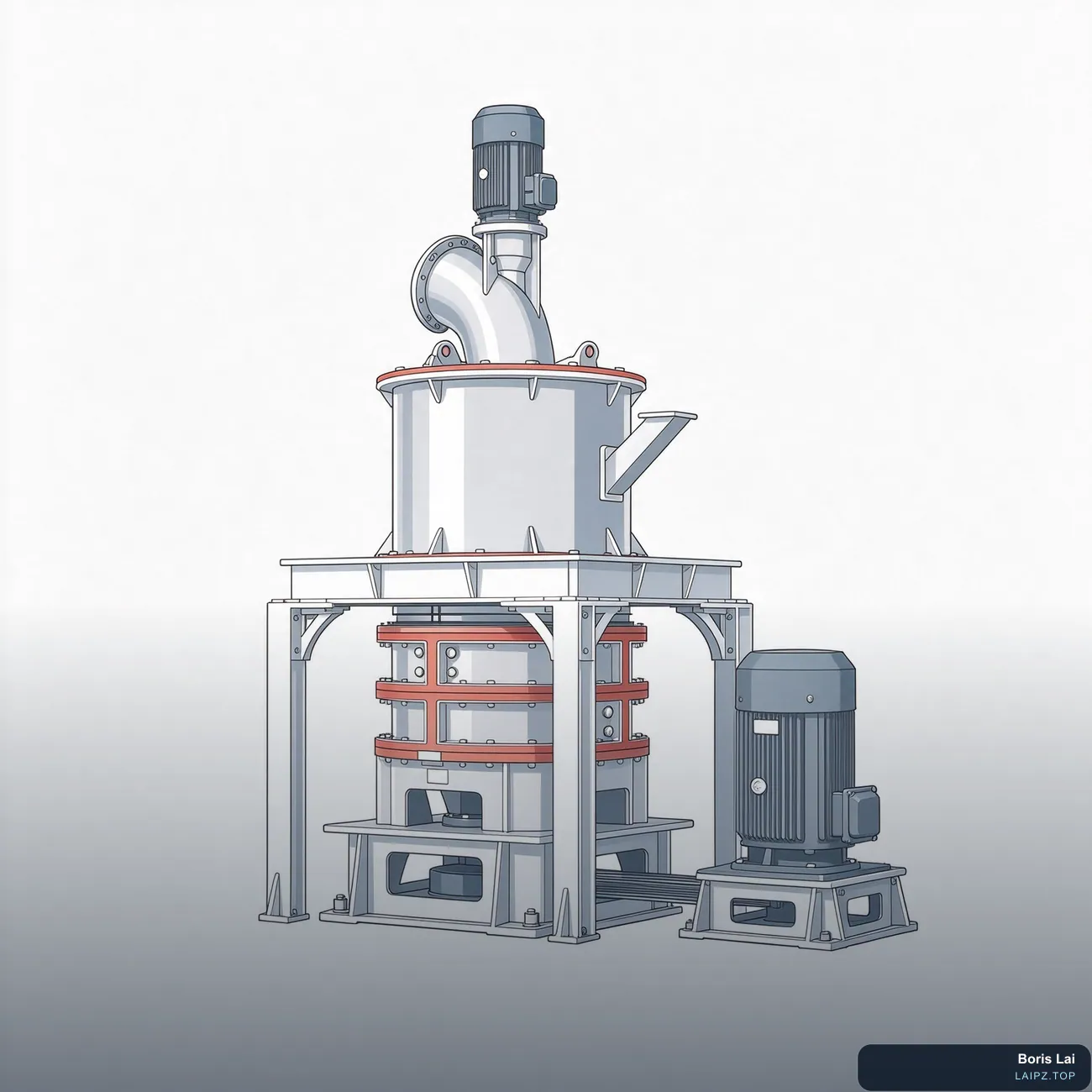
The machine combines pressure grinding, airflow transport and dynamic classification. Coarse particles return to the grinding zone while finished powder moves into the collection system.
Inside the system
Material is fed into the grinding chamber, where rollers press against the grinding ring. Air lifts the ground particles to the classifier. The coarse fraction returns for another pass, and the fine fraction exits through the dust collector.
Integrated classifier
Adjusts the top particle size without changing the whole grinding circuit.
Replaceable wear parts
Rollers, ring segments and classifier elements define the service plan.
Negative-pressure operation
Dust collector, fan and sealed conveying support a cleaner production area.
Machine structure
Stabilizes the material flow entering the mill and helps protect the grinding zone from surge loading.
Provides the stationary grinding surface against which the rollers apply pressure.
Transfer centrifugal and spring pressure to the material bed for fine comminution.
Separates particles by size. Rotor speed and airflow influence the finished-powder cut.
Captures finished powder and supports controlled dust emission from the circuit.
Maintains the circulating airflow that transports material through grinding and classification.
Helps manage the air circuit and discharge path while maintaining stable negative pressure.
Screw conveyor, bucket elevator and intermediate silo connect the mill to storage and packing.
Working principle
Crush and meter the material into a stable size and flow range.
Rollers run against the ring, reducing particles in a high-turbulence grinding zone.
The classifier returns coarse particles and releases the selected fine fraction.
Powder is separated in the collector, discharged and transferred to storage or packing.


Crusher, apron feeder, mill, classifier, collector, fan, conveying and finished-powder storage are reviewed together.
Fine range
Use one grinding platform across a broad fine-powder envelope, then set the operating point with the classifier and air balance.
Compact circuit
Grinding and classification work in the same compact circuit, which can reduce the number of separate process stages.
Maintenance
Rollers, ring segments, classifier parts and valves can be planned as a defined spare-parts program.
Powder handling
The collector and negative-pressure circuit support cleaner material handling around grinding and discharge.
Applications
Representative material references below are illustrative. Final suitability is confirmed from the buyer's material analysis, hardness, moisture and finished-powder specification.

Coatings, plastic fillers, sealants, paper and calcium carbonate compounds.

Mineral fillers, construction materials, industrial powder and desulfurization applications.

Plastics, coatings, ceramics, rubber and other low-hardness mineral applications.

Ceramics, paper, coatings, rubber and specialty clay-based products.

Environmental treatment, construction chemistry and hydrated-lime powder lines.

Plastics, paints, rubber, paper and functional mineral filler systems.
Capacity and achievable top size vary with material grindability, feed size, moisture and target particle-size distribution. Pre-project testing is recommended for high-value or tightly specified products.
Representative project profiles
These profiles illustrate typical screening scenarios, not customer names or production guarantees. Final configurations are confirmed through material testing and engineering review.

Target 800-1250 mesh with an emphasis on top-size control, stable classifier operation and finished-powder collection.

A circuit brief focused on the roller-ring interface, classifier settings and wear-part access for fine mineral production.

A production-line screening case combining feed preparation, ring roller milling, classification and dust-controlled collection.
Specification screening
The table is a screening guide, not a final quotation. Capacity falls as target fineness increases and varies with the material being processed.
| Reference class | Fineness envelope | Project capacity | Main motor range | Typical line scope |
|---|---|---|---|---|
| RRM-800 | 120-2500 mesh | 0.5-2.5 t/h | 45-75 kW | Feed, grinding, classifier, dust collection |
| RRM-1000 | 120-2500 mesh | 1.5-5 t/h | 75-110 kW | Integrated mill and conveying route |
| RRM-1250 | 120-2500 mesh | 4-10 t/h | 110-200 kW | Complete powder line screening |
| RRM-1600 | 120-2500 mesh | 8-20 t/h | 180-315 kW | High-capacity mill and auxiliary system |
| Custom multi-unit | 120-2500 mesh | Application-specific | Project-specific | Multiple mills, storage and packing integration |
Nominal tonnage should be stated at the required mesh, not at the coarsest possible setting.
Clarify D97 or a full particle-size curve when the finished powder has a critical specification.
Voltage, frequency, compressed air, water and local ambient conditions belong in the equipment brief.
Available height, floor area, material storage and discharge layout can change the recommended line scope.
Equipment comparison
Ring roller mills sit in the fine-powder space. A Raymond mill can be a practical medium-fine route, while a ball mill may suit different feed, hardness or tonnage conditions. The comparison should include the complete circuit.
| Decision point | Ring roller mill | Raymond mill | Ball mill |
|---|---|---|---|
| Best fit | Fine dry mineral powder | Medium-fine powder | Broader grinding and blending duty |
| Fineness control | Integrated dynamic classifier | Classifier based | Circuit and separation dependent |
| Footprint | Compact integrated circuit | Compact conventional circuit | Typically more extensive |
| Maintenance pattern | Rollers, ring segments, classifier | Roller and ring replacement | Liners, media and drive system |
| Typical decision | Targeted fine-powder production | Established medium-fine duty | Feed conditions or throughput requirements |
Spare parts and wear planning
Wear-part selection should match the material's abrasiveness and the mill's actual operating point. I help coordinate original-parts channels, traceable specifications and delivery timing.
Check wear profile, bearing condition and installation clearance.
Match material and replacement interval to abrasive load.
Inspect balance, wear and the effect on finished-particle cut.
Confirm dimensional traceability and fit with the roller assembly.
Maintain stable airflow and material discharge under negative pressure.
Build a practical consumables stock based on expected operating hours.
Coordinate the correct parts reference with the equipment supplier and document the offered specification.
Keep model, drawing and material details aligned so replacements do not depend on assumptions.
Compare part scope, price basis, packing and lead time in a format that can be reviewed line by line.
Plan routine spares with the shipment and flag critical wear parts before the first maintenance cycle.
Selection guide
A clear brief reduces quotations that cannot be compared. Start with the material and finished-powder target, then define the production and site conditions.
Name, hardness, feed size, moisture and any chemical constraints.
Mesh range, D97 or particle-size curve, whiteness or special handling needs.
Nominal tonnes per hour at the actual finished-fineness target.
Voltage, frequency, available height, climate and material-storage plan.
Whether the scope starts at the crusher, mill only, or continues to packing.
After-sales and support
The broker role is to keep technical, commercial and service questions connected through delivery and the first maintenance cycle.

Clarify the material, powder target, capacity and line boundary.
Align comparable mill models and auxiliary scope with qualified suppliers.
Request a traceable technical and commercial basis for review.
Coordinate inspection points, packing details and shipment questions.
Connect the buyer with the supplier's technical team and documentation.
Maintain a parts reference and plan routine replacement timing.
Match fineness, capacity and auxiliary equipment to the production brief.
Coordinate the same technical scope so proposals can be reviewed clearly.
Keep replacement parts, documentation and delivery questions traceable.
Related sourcing options
The ring roller mill is the focus of this page. Related equipment can still be reviewed when the material, fineness, capacity or project stage points to a different route.

Consider when the product specification and capacity align with a conventional medium-fine milling circuit.

Reviewed for projects where vertical grinding or a different ultrafine circuit is a stronger process fit.
Review feed preparation, milling, classification, collection and finished-powder handling as one scope.
Buyer FAQ
If your answer is not listed, send the material and target powder details through the inquiry form.
It is used for dry fine grinding of non-metallic minerals. Rollers press material against a ring, air transports the ground particles, and a classifier controls which particles leave the mill.
The fineness range for the projects represented here is 120-2500 mesh. The practical operating point depends on the material, target particle-size distribution, desired capacity and classifier setup.
Representative materials include calcite, limestone, talc, kaolin, calcium hydroxide and calcium carbonate. Hardness, moisture, feed size and impurities should be reviewed before selection.
Reference project classes range from roughly 0.5 t/h to 20 t/h, with custom multi-unit systems for higher output. Capacity must be stated at the required mesh rather than only at a coarse setting.
Start with raw material, target mesh, D97 or particle-size curve, required tonnes per hour, feed size and material moisture. Then compare mill size, classifier configuration and installed power.
The allowable feed size and moisture depend on the selected mill and upstream equipment. A crusher, dryer or different feed preparation may be needed if the raw material is too coarse or too wet.
Voltage and frequency are project-specific. Provide your local three-phase voltage, frequency, control voltage and any site electrical requirements before the quotation is prepared.
Grinding rollers, grinding ring segments, classifier elements, shaft pins, seals and some valves or conveying components should be included in the maintenance review. Wear rate depends heavily on material abrasiveness.
Yes. The broker role includes coordinating the parts reference, offered specification, packing and lead time with the relevant supplier or original-parts channel.
Lead time depends on the model, line scope, customization, component availability and shipping method. It should be stated by line item in the supplier's offer rather than assumed from a generic figure.
Yes. The scope can include supplier documentation, remote technical communication and, where offered, on-site installation or commissioning support. The exact arrangement belongs in the commercial scope.
A ring roller mill is presented here for fine-powder projects with integrated classification and a compact circuit. A Raymond mill may remain appropriate for medium-fine applications. The comparison should use the target powder and whole-line economics.
News & Insights
Short technical notes on materials, mill comparison and production-line layout for 120-2500 mesh mineral powder projects.
Start with your material brief
For a useful first response, include the raw material, target fineness, required output and any site or voltage constraints.
Boris Lai
Direct email and phone contact. No third-party chat widget.